
Key Ideas & Takeaways
Small Habits Create Big Results
One of the biggest lessons from the book is that success rarely comes from one massive breakthrough.
Instead, it comes from tiny improvements that compound over time.
James Clear introduces the idea of The Aggregation of Marginal Gains : breaking a skill into its smallest components and improving each by just 1%.
A 1% improvement seems insignificant today, but over time it becomes transformational.
* 1% better every day for one year → 37× better (1.01^365 ≈ 37.8)
* 1% worse every day for one year → almost 0 (0.99^365 ≈ 0.03)
Small habits appear insignificant in the present but remarkable in hindsight.
Your quality of life is ultimately a reflection of the quality of your habits.
The same habits produce the same results.
Progress Is About Trajectory, Not Today
Instead of obsessing over current results, pay attention to your current direction.
The book compares habits to bamboo. For years, it appears nothing is happening beneath the surface before rapid visible growth suddenly occurs.
This is what James Clear calls the Plateau of Latent Potential
Most people quit during this plateau because they don't see immediate progress.
Those who persist long enough eventually break through, and everyone else labels it "overnight success."
The breakthrough wasn't sudden, it was simply the accumulated result of hundreds of small actions.
Focus on Systems, Not Goals
One of my favourite ideas from the book is:
Goals set direction - Systems create progress.
Goals tell you where you want to go.
Systems determine whether you'll actually get there.
Interestingly, James Clear argues that focusing only on goals creates several problems:
* Winners and losers often share the exact same goals.
* Achieving a goal changes your life only momentarily.
* Goals can delay happiness by making you think success lies somewhere in the future.
* Goals encourage finishing instead of continuing.
A well-designed system keeps producing results long after a single goal has been achieved.
Identity Is the Foundation of Habits
One of the most powerful concepts in the book is that change happens at three different levels.
Outcomes
Changing your results. Examples:
* Losing weight
* Publishing a book
* Winning a championship
Most people set goals at this level.
Processes
Changing your routines and systems. Examples:
* Going to the gym
* Meal prepping
* Meditation
* Decluttering your workspace
Most habits are built here.
Identity
Changing what you believe about yourself. This is where lasting transformation happens.
Instead of saying:
I want to run.
Become:
I am a runner
Instead of:
I want to read
Become:
I am someone who reads every day
Habits aren't about achieving something. They're about becoming someone.
Every action is a vote for the type of person you wish to become. No single action changes your identity.
But thousands of repeated actions slowly become undeniable evidence.
The book reduces lasting change into two simple steps:
1. Decide the type of person you want to become.
2. Prove it to yourself with small wins every day.
The Habit Loop
Every habit follows the same four-step cycle.
Cue → Craving → Response → Reward
* Cue identifies a potential reward.
* Craving creates the desire to act.
* Response is the actual behaviour.
* Reward satisfies the craving and reinforces the habit.
Repeat this loop enough times and the behaviour becomes automatic.
The Four Laws of Behavior Change
James Clear structures habit building around four simple principles.
1. Make it Obvious
2. Make it Attractive
3. Make it Easy
4. Make it Satisfying
Almost every strategy in the book fits into one of these four laws.
Make Good Habits Obvious
Before changing your habits, you first need to become aware of them.
The book recommends creating a Habit Scorecard.
Write down your daily habits and mark each as:
* ✅ Positive
* ❌ Negative
* ➖ Neutral
Awareness always comes before improvement.
Another technique I found interesting is Pointing and Calling, a method commonly used in Japanese railways.
Physically pointing at an action and verbally acknowledging it dramatically reduces errors because it forces your brain to become conscious of what would otherwise be automatic.
James Clear also introduces Implementation Intentions.
Instead of saying:
I'll exercise more.
Say:
When it is 7:00 AM, I will go to the gym.
Or:
After making coffee, I will meditate for five minutes.
Specificity dramatically increases follow-through.
Design Your Environment
One of the strongest messages throughout the book is that environment often beats willpower
Our surroundings constantly influence our behaviour.
Humans have around 11 million sensory receptors, and roughly 10 million are dedicated to vision.
Simply changing what you see every day changes what you naturally do.
Some ideas that stood out:
* Design one space for one purpose.
* Make good habits visible.
* Hide cues for bad habits.
* Create environments where the desired behaviour feels natural.
James Clear argues that people with high self-control usually aren't better at resisting temptation.
They're simply better at avoiding it.
It's easier to avoid temptation than resist it repeatedly.
Make Habits Attractive
Dopamine isn't released only when we receive rewards.
It's released when we anticipate them. Wanting drives behaviour more than liking.
This explains why attractive habits become automatic. One useful strategy is Temptation Bundling.
Combine something you need to do with something you enjoy.
For example:
* After my workout, I'll listen to my favourite podcast.
* After finishing my study session, I'll watch an episode of my favourite show.
The book also recommends joining communities where your desired behaviour is already normal.
The easiest habits to maintain are often the ones supported by your social circle.
Action Beats Motion
Planning feels productive. Research feels productive. Learning feels productive.
But none of them produce results by themselves.
James Clear distinguishes between Motion and Action.
Motion is preparation. Action produces outcomes. The goal isn't perfection.
It's repetition.
Master the habit of showing up first. The details can improve later.
Make Habits Easy
Humans naturally choose the path requiring the least effort. Instead of relying on motivation, reduce friction.
Some practical ideas include:
* Prepare everything the night before.
* Keep your workout clothes ready.
* Place books where you'll naturally see them.
* Remove distractions before work.
The reverse also works.
Increase friction for bad habits. Delete distracting apps. Keep unhealthy food out of sight. Make undesirable behaviours inconvenient.
James Clear also introduces the idea of Gateway Habits.
Start with habits so small they feel impossible to skip. Reading one page. Doing one push-up. Meditating for one minute.
Consistency matters more than intensity. Master showing up before mastering performance.
Make Habits Satisfying
Behaviours followed by satisfying consequences are more likely to be repeated.
Those followed by unpleasant consequences gradually disappear.
Every habit follows a simple feedback loop:
Try > Fail > Learn > Adjust > Repeat.
Improvement isn't linear. It's iterative.
The people who succeed aren't those who never fail. They're the ones who continue refining their systems.
Final Thoughts
My biggest takeaway from Atomic Habits is that lasting change has very little to do with motivation.
Instead, it comes from designing systems, shaping your environment, and becoming the type of person who naturally performs the habits you want.
Tiny actions repeated consistently matter far more than occasional bursts of motivation.
Perhaps my favourite idea from the entire book is this:
Every action you take is a vote for the person you wish to become.
That single sentence perfectly captures the essence of the book.
If you're trying to become healthier, build a business, improve your career, or simply become a better version of yourself,
Atomic Habits provides one of the most practical frameworks I've come across.
Keep reading
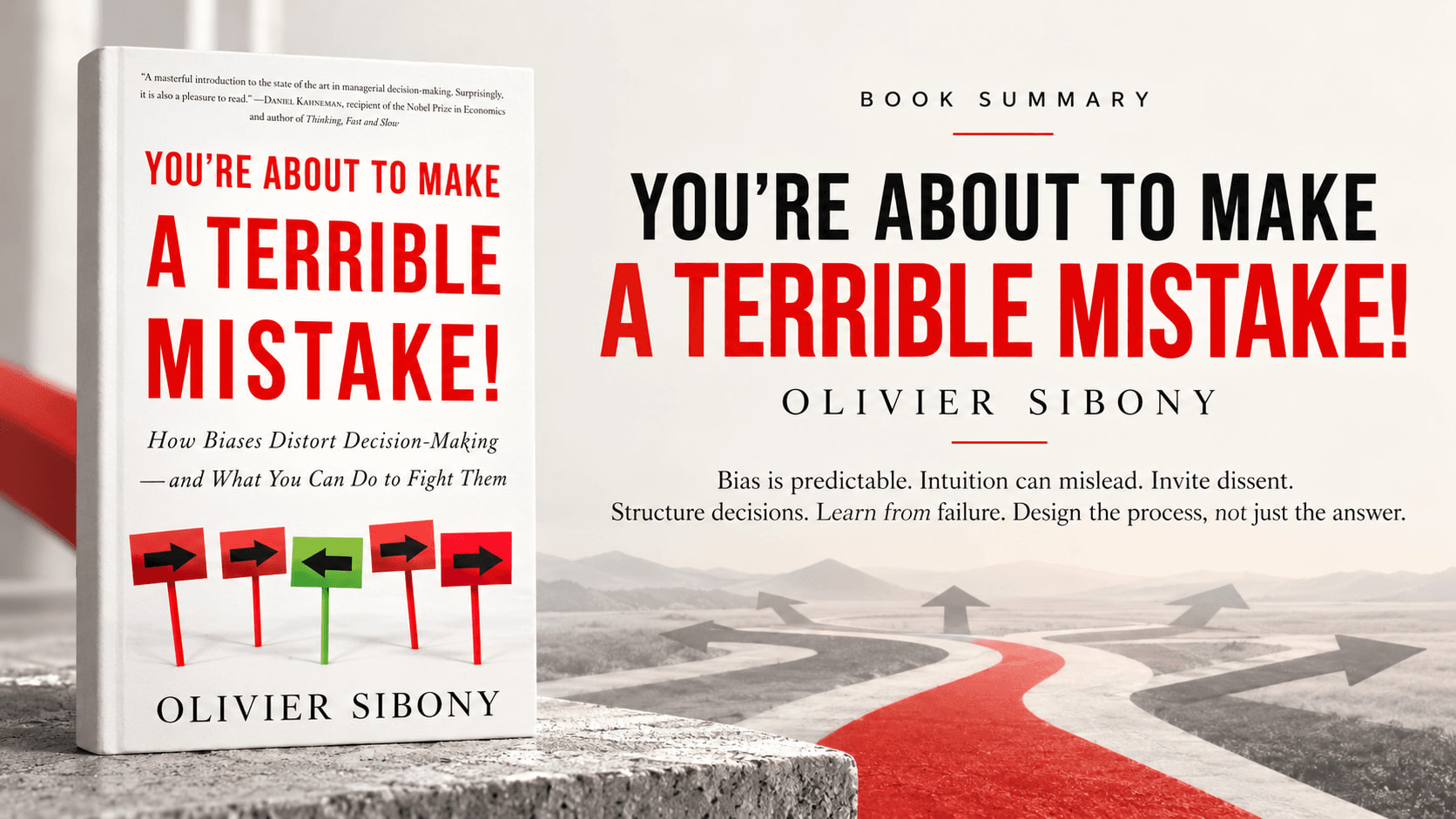
You're About to Make a Terrible Mistake by Oliver Sibony
Whether you're making business decisions, investing, hiring, or planning your career, your biggest enemy often isn't a lack of information. It's the biases hidden inside your own thinking.

100M Leads: by Alex Hormozi
How do you consistently get more people interested in what you sell?Most businesses don't have a product problem but an attention problem. You can't sell to people who don't know you exist !